Are you looking for an activity that combines fun, learning, and development?
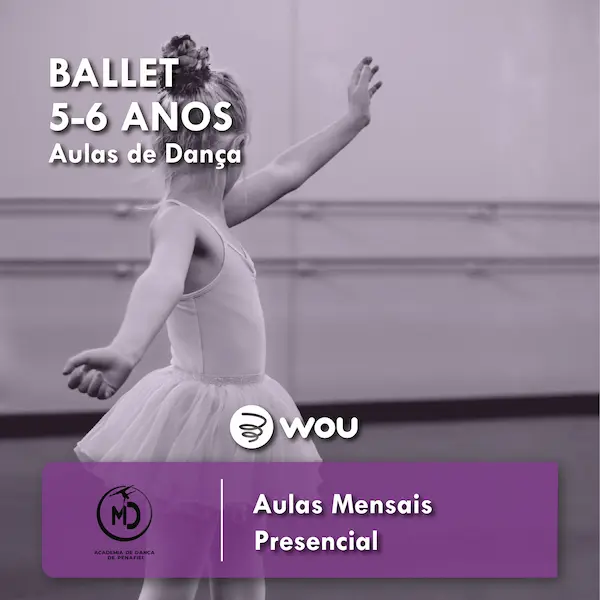
The ballet classes for children aged 5 to 6 in Penafiel are perfect for this stage of growth, where coordination, posture, and musicality begin to consolidate. In a safe and motivating environment, young dancers develop discipline and focus while discovering the joy of dance.
At this age, children’s ballet goes beyond fun: it improves balance, flexibility, and rhythm, while also stimulating creativity and self-expression. Children learn to follow simple movement sequences and begin to acquire basic notions of choreography, always in a playful and age-appropriate way.
With the guidance of experienced and passionate teachers, each student is encouraged to progress at their own pace, building confidence, self-esteem, and new friendships.
Enroll your child today in ballet classes in Penafiel (5–6 years) and watch how dance can turn this stage of childhood into unforgettable moments of growth and joy.
Price Includes
- Monthly Lesson Plan throughout the school year
Price doesn't Include
- Registration and Insurance, which are completed at the school at the time of enrollment
Other Activities of Interest
- Ballet Classes (7–8 years old) in Penafiel
- Contemporary Dance Classes (8–11 years old) in Penafiel
- Hip Hop Classes (6–8 years old) in Penafiel
About MissisDance
MissisDance – Dance Academy, founded in December 2017 as the MissisDance Project, promotes artistic education in Penafiel. Since April 2021, it has been offering styles such as Classical Dance (Ballet), Hip Hop, Contemporary Dance, Floor Barre, and Yoga, as well as Choreographic Workshops.
The academy focuses on personalized learning, welcoming both those who seek leisure and physical activity, and those who wish to pursue a career in the Performing Arts.
More Information
If you have anything else send us a whatsapp message on this issue link.
Contact WOU: 918 136 805
1. How long are the classes and how many times per week are recommended?
A: Ballet classes for children aged 5 to 6 last about 45 to 50 minutes, with a recommended frequency of 1 to 2 times per week, depending on the child’s progress.
2. What is the difference between ballet for 5–6-year-olds and for 4-year-olds?
A: At this stage, children already have greater coordination and concentration, which allows them to work on simple sequences, rhythm, and posture. The training is more structured but still playful.
3. What are the main benefits of ballet for 5–6-year-olds?
A: It improves posture, flexibility, and balance, develops discipline, musicality, and choreographic memory, and increases confidence in group settings.
4. What uniform is recommended for this age group?
A: It is recommended to wear a leotard/tights and full-sole ballet shoes. A bun hairstyle is required to ensure discipline and safety during movement.
5. Are pointe shoes used in 5–6-year-old classes?
A: No. Pointe shoes are only introduced at later ages, when there is enough bone maturity and technical preparation.
6. How many students are usually in each class?
A: Classes are kept small to guarantee individual attention and pedagogical quality.
7. Can ballet at this age also help with school performance?
A: Yes. Ballet improves attention, memory, and discipline, which can have positive effects on a child’s concentration and organization at school.
8. Is it possible to take a trial class before enrollment?
A: Yes. A trial class can be scheduled, subject to availability, to get to know the space and teaching methodology.
9. What is included in the price?
A: The monthly plan includes only the classes. Registration and insurance are completed at the school at the time of enrollment.
10. Is ballet suitable for shy or very active children?
A: Yes. Shy children gain confidence and expression, while very active children learn to channel energy, focus, and follow rules.
11. Are there performances or showcases at this age?
A: Yes. The school may organize small showcases or presentations, helping children build stage confidence and share their progress with family.
12. How does progression work after the age of 6?
A: After this stage, children move on to the 7–8-year-old level, where technique is reinforced, and movements become more complex.