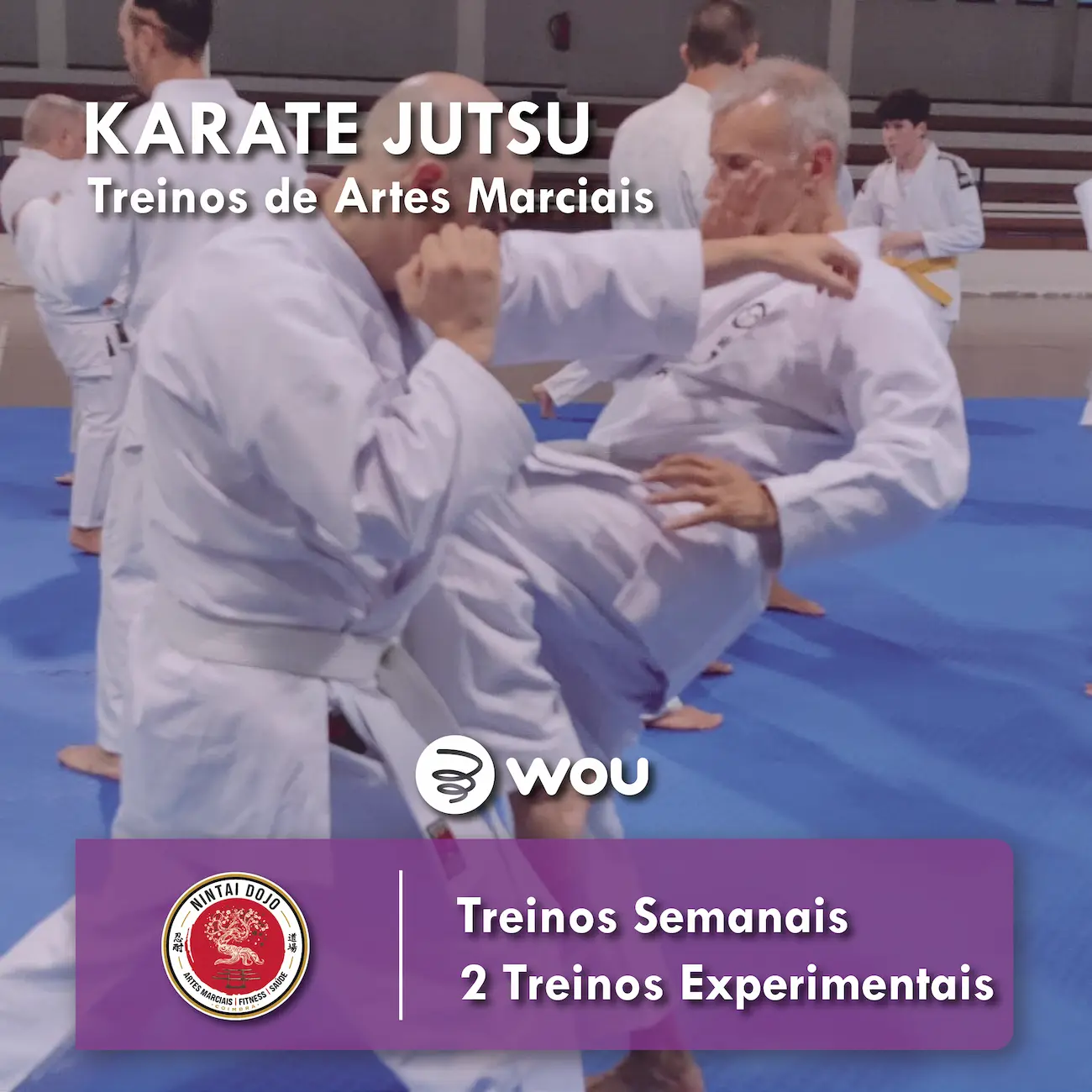
The Karate that returns to its origins. Effective, technical and applied.
Karate Jutsu is not sport Karate. It is a traditional martial art that returns to the essence of real combat — with striking, throwing and immobilisation techniques developed for real self-defence situations. A living martial art, in constant evolution, with roots in Okinawa and internationally recognised by the IAKJ (International Association of Karate Jutsu).
In São Martinho do Bispo, Coimbra, training sessions are led by Pedro Seguro, IAKJ certified Master Coach, with extensive experience in teaching Karate Jutsu and a direct connection to the Santa Clara Coimbra Karate school — one of the reference IAKJ dojos in Portugal.
The first two training sessions are free — no commitment, no pressure. Come and try it and feel the difference.
What is worked on in training
- Self-Defence: striking, throwing and immobilisation techniques applied to real scenarios
- Physical Conditioning: endurance, strength, flexibility and motor coordination
- Mental Discipline: focus, emotional control and overcoming personal limits
- Traditional Technique: rigorous teaching based on the original principles of Karate Jutsu
Sign up now and discover one of the most complete and applied martial arts you can practise.
Who are the training sessions for?
For young people and adults aged 13 and above — both for those who want to start in martial arts and for practitioners looking for a more applied and traditional approach to Karate. Teaching adapts to the level of each practitioner, from beginner to advanced.
Benefits
- Effective self-defence: techniques applied to real situations
- Complete physical fitness: strength, agility and endurance
- Discipline and emotional control — skills for life
- IAKJ certified training: international recognition
- Safe and supervised environment: controlled and progressive contact
Price Includes
- 1 session per week
- 2 free trial sessions — no commitment
Price Does Not Include
- Annual registration, insurance and IAKJ annual membership fee
About Nintai Dojo
Located in S. Martinho do Bispo, Coimbra, Nintai Dojo — 'The Dojo of Perseverance and Hope' — was born from the expansion of the Shukokai Karate Santa Clara school to create a new hub for Martial Arts, Fitness and Health. Inspired by the Japanese concept of resilience and serenity (Nintai), the space goes beyond Karate, integrating Yoga, Functional Training and Self-Defence in an environment dedicated to personal growth and physical and mental wellbeing.
More Information
If you have any questions, send us a message on WhatsApp through this link.
Contact WOU: +351 918 136 805
1. What is Karate Jutsu and how does it differ from sport Karate?
A: Karate Jutsu is a traditional martial art focused on the real effectiveness of combat, with striking, throwing and immobilisation techniques applied to real self-defence situations. Unlike sport Karate — oriented towards competition with specific rules — Karate Jutsu prioritises practical application and character development, remaining true to the origins of the martial art.
2. What is the IAKJ and why does it matter?
A: The IAKJ (International Association of Karate Jutsu) is the international organisation that certifies and regulates Karate Jutsu worldwide. Training sessions in São Martinho do Bispo are led by Pedro Seguro, IAKJ certified Master Coach — a guarantee of quality, technical rigour and international recognition.
3. How do the first two free training sessions work?
A: The first two training sessions are completely free and with no commitment whatsoever. It is the ideal opportunity to get to know the dojo, the instructor and experience Karate Jutsu before deciding to sign up. Simply contact us and show up.
4. What are the costs after the free training sessions?
A: After the two free training sessions, the costs are: annual registration of €35 and insurance with annual IAKJ membership of €50. The monthly training fee is €35/month for 1 training session per week.
5. Do I need prior martial arts experience?
A: No. Training sessions are structured to welcome all levels, from absolute beginners to experienced practitioners. Teaching adapts to the technical evolution of each practitioner.
6. Why is the minimum age 13?
A: Karate Jutsu involves self-defence techniques and a physical and mental maturity requirement that is better suited to young people and adults aged 13 and above. For younger children, we recommend Karate Shukokai training sessions, focused on psychomotor and playful development.
7. Is training violent? Can I get hurt?
A: Safety is the top priority. Although it is a contact martial art, all training is supervised and controlled. Practitioners learn to control their strength and respect their training partner, minimising the risk of injury.
8. What equipment is needed to start?
A: For the first training sessions, comfortable sportswear that allows freedom of movement is all that is needed. The kimono (gi) and belt are purchased after the decision to enrol — the instructor will advise on the necessary equipment at the time of registration.